 Rheafinance
 lending
Updated:RHEA Lending is RHEA Finance’s market for loans backed by supplied collateral. Borrowing is overcollateralized, with risk factors and interest curves that differ by asset.
- Collateral risk
- Each asset has its own volatility factor. Collateral remains subject to liquidation under the lending market’s rules.
- Interest model
- A separate dynamic interest curve for each asset.
- Network scope
- NEAR lending and cross-chain lending across supported token and network combinations.
- Market reopening
- RHEA requires an independent audit before an affected market reopens and restores markets individually.
What must be ready before borrowing?
The selected lending market must accept the collateral that will back the loan. Identify the asset to borrow separately, then review each asset’s volatility factor and interest terms.
Cross-chain lending support depends on the asset and network combination. Confirm that both the collateral market and the intended borrowing market are available before supplying funds for that loan.
Which assets and collateral options are documented?
RHEA’s lending catalogue lists token markets with different network coverage. The RHEA Finance White Paper separately describes LP-token and xRHEA collateral uses. Those designs require confirmation of an available market for the specific collateral asset.
| Asset or position | Lending relationship | Product context | Documented network scope |
|---|---|---|---|
| USDC | Listed token lending market. | Cross-chain lending catalogue. | Includes Sui, Solana and NEAR. |
| USDT | Listed token lending market. | Cross-chain lending catalogue. | Includes Tron, Solana and NEAR. |
| ZEC | Listed token lending market. | Cross-chain lending catalogue. | Zcash, Solana and NEAR. |
| BTC | Listed token lending market. | Cross-chain lending catalogue. | Bitcoin and NEAR. |
| NEAR | Listed token lending market. | Cross-chain lending catalogue. | NEAR and BSC. |
| DEX LP tokens | The white paper describes collateral use while farming incentives continue. | DEX-linked lending design. | RHEA’s NEAR DEX and lending context. |
| xRHEA | The white paper describes lending and collateral use after staking RHEA to receive xRHEA. | RHEA staking and lending design. | Initial token distribution on NEAR. |
| Compare market-specific risk and interest terms separately from network coverage. | |||
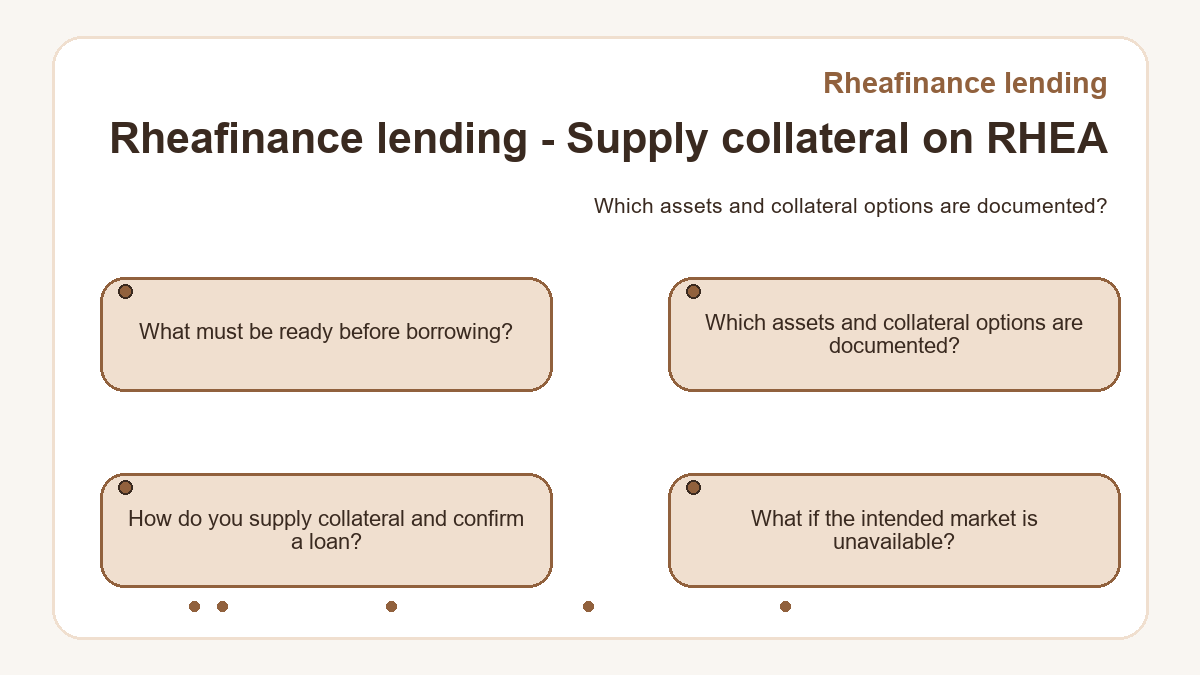
Rheafinance lending - Supply collateral on RHEA
- What must be ready before borrowing?
- Which assets and collateral options are documented?
- How do you supply collateral and confirm a loan?
- What if the intended market is unavailable?
How do you supply collateral and confirm a loan?
Note the lending account’s current supplied balance, designated collateral and debt. Supply an accepted asset as collateral if needed. In NEAR lending, eligible assets already supplied can instead be designated as collateral. Choose a borrowing asset and an amount that meets the market’s collateral requirements. Review the loan details and authorize the borrowing request. Check the recorded collateral, updated debt and receipt of the borrowed asset. A signed or submitted request alone does not establish that all those outcomes occurred.
For a cross-chain loan, receipt must also match the intended asset and destination network. Keep the loan’s debt position separate from the delivery outcome when assessing completion.
What if the intended market is unavailable?
Stop before supplying funds for that loan if its required market is unavailable. RHEA’s reopening policy applies market by market, so a broad lending status does not confirm every market’s readiness. Changing the collateral asset or network requires reviewing the replacement market’s terms.